



5:30 AM | Municipal Road Emergency Repair Site
The sky was still dark when the alarm sounded.
An overnight downpour had washed out a section of the roadbed, and the municipal repair team arrived through the night. I rolled off the flatbed truck, my tires gripping the asphalt directly — that's the advantage of a wheeled excavator: no steel plates needed, no road damage, ready to go wherever duty calls.
On the narrow one-way street, semi-trailers couldn't get in and tracked excavators couldn't turn around. Only I could squeeze through. Outriggers deployed, the bucket descended with precision, and the collapse was cleared in 20 minutes. Traffic was restored before the morning rush.
Wheeled Excavator Tip: Municipal work demands "fast in, fast out." Check tire pressure and steering before relocating. In tight spaces, use micro-operation mode to avoid scraping roadside fixtures.
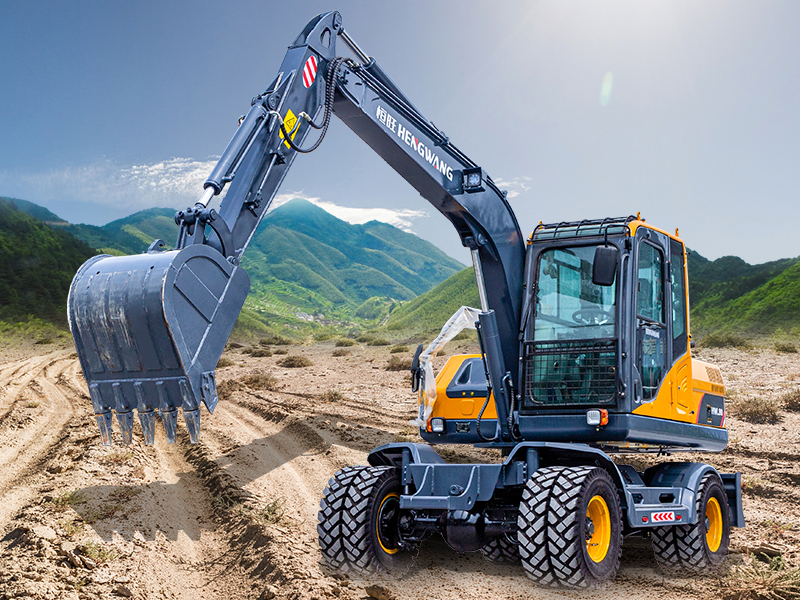
8:00 AM | Suburban Farmland Irrigation Project
The sun had just risen when I arrived at the second site.
The village's irrigation canal had been blocked for half the summer, with over a meter of silt accumulated. Tracked excavators risk getting stuck in these conditions, but I switched to narrow tires, crossed the field ridges at a steady pace, and stayed stable even on soft ground. Bucket dredging, slope trimming, canal shaping — all in one smooth sequence. By noon, all three canals were flowing again.
During farming season, time means harvest.
Wheeled Excavator Tip: Preventing bogging down is critical in farmland. On soft ground, lower your center of gravity, make gradual turns, and avoid prolonged repeated operation in the same spot.
11:00 AM | Old Urban District Demolition Site
The third job: a street-facing small building slated for demolition.
The structure stood right next to residential buildings — large equipment couldn't access it, and manual demolition was too slow. I drove through the building entrance, my roof barely clearing the frame. The wheeled excavator's compact dimensions are designed for exactly this kind of "tight-quarters operation."
Retract the arm, swing, lower the bucket — every movement controlled to the centimeter. In two hours, the three-story building was leveled, and not a single pane of glass next door was cracked.
Wheeled Excavator Tip: Indoor and confined-space demolition must prioritize stability. Confirm floor load-bearing capacity in advance, reduce engine RPM for finer control, and maintain safe distances from ground crew.
1:30 PM | Mining Quarry
Lunch was eaten in the cab. The afternoon's job was tougher.
At the quarry, I swapped in a hydraulic breaker and went to work on the rock face. Heavy dust and high loads put the hydraulic system to a real test. Every two hours, I "take a breath" — check oil temperature, clean the air filter. That's the rule old drivers taught me.
Hard rock takes patience.
Wheeled Excavator Tip: Under heavy mining loads, pay close attention to hydraulic oil temperature and return-line filters. Avoid prolonged full-load breaker operation, and regularly inspect pins and bushings for wear.
4:00 PM | Municipal Landscaping Belt
Coming down from the mine, I "took a shower," swapped back to a clean bucket, and headed to the fourth site — the city's green belt.
A batch of mature plane trees needed transplanting. The pits had to be round, vertical, and precisely deep — one centimeter too deep damages the roots, one centimeter too shallow and the tree won't survive. I used micro-operation to carefully shape each pit, and the workers gave a thumbs-up.
Rough work, fine work — I can do both.
Wheeled Excavator Tip: Landscaping demands precision. Use idle or low-speed mode with manual fine-tuning. Keep a steady speed when trimming slopes with the bucket edge to avoid "gouging" the pit.
6:30 PM | Highway Emergency Lane
It was rush hour, but I was on the highway — not driving through, but working.
A truck had overturned ahead, cargo scattered across the emergency lane. I exited at the nearest ramp, drove along the shoulder to the scene, and completed debris clearance, cargo removal, and road restoration in 40 minutes.
Tracked excavators wait for flatbed trucks. I drive myself. That's the difference.
Wheeled Excavator Tip: Obey traffic rules during road relocation; check lights and reflective markers. During highway emergency work, outriggers must be fully extended and blocked with timber to ensure lateral stability.
9:00 PM | Back at the Depot
Six job sites in one day, three different attachments, five types of work: dredging, demolition, breaking, tree planting, and debris clearance.
Before calling it a day, the old routine: a full walk-around inspection — check tires for nails, hydraulic hoses for leaks, whether the air filter needs blowing. Fluids topped up, ready for tomorrow.
People often ask: what exactly can a wheeled excavator do?
The answer is: wherever it's needed, it can go there.
From the pre-dawn repair site to the late-night shutdown check, from city streets to deep in the mines, from delicate landscaping to rugged demolition — the value of a wheeled excavator was never just "digging dirt." It's stepping up in every scenario that needs it.
Hengwang Wheeled Excavators — full-scene adaptation, worry-free across all working conditions.

Please fill out the form below according to your needs, and a Hengwang product specialist will contact you within one day.